


She was maybe six years old the first time she picked up a needle to sew a Hmong cloth.
No instructions. No YouTube tutorial. Just her grandmother's hands, moving slowly so she could follow.
Stitch by stitch, the pattern appeared — a spiral that meant family. A diamond that meant home. A flower that meant we are still here.
This is how paj ntaub — flower cloth — has survived for centuries. Not in libraries. Not on Wikipedia. In the hands of women who learned from their grandmothers, who learned from theirs. Across generations of mountains and borders and everything the world threw at them.
At Lumily, we've carried pieces of this tradition for years. Every upcycled bag in our collection is made from real vintage paj ntaub fabric. The actual cloth these women made. And every time we hold one, we want you to know what you're really holding.
So. Let's talk about it.
Wait — What Is Hmong Paj Ntaub, Exactly?
Paj ntaub (say it: pa ndau) means "flower cloth" in Hmong. It's the name for the traditional hand embroidery that women have made for generations. Intricate, geometric, absolutely stunning to look at.
But here's what most people don't know: it started as an act of survival.

For centuries, the Hmong people had no written language. Their history lived in stories told out loud, passed ear to ear. Then came waves of persecution. They were forced to flee, forced to assimilate, forbidden from using their own language. Their culture was being erased, deliberately and systematically.
So the women did something brilliant.
They hid their language inside their clothing.
"What looked like decoration to outsiders was, to those who could read it, a letter. A family record. A prayer. A history that couldn't beburned."
Motifs that seemed purely decorative were actually coded symbols. Clan identity, spiritual protection, family lineage, messages of love and warning. All of it, stitched into fabric you could carry across borders on your own body.
That spiral on your bag? It's not a pattern. It's a family tree. The border of triangles? Protective armor. The elephant foot? An anchor. Everything means something.
Then Came the Story Cloths — and Everything Changed

Traditional paj ntaub uses geometric abstraction — the kind of patterns you'll recognize on our bags and clutches. But in the late 1970s, something new and heartbreaking emerged.
After the Vietnam War, thousands of Hmong people were forced to flee Laos. Many of them had fought alongside American forces. They crossed the Mekong River at night. Many didn't make it. Those who did ended up in Thai refugee camps with almost nothing.
In those camps, the women started stitching something different. Not symbols. Scenes.
Rice harvests. Children playing in the village. The river crossing at night. Soldiers. Flight. Loss. Memory.
These were the first story cloths — embroidered testimony. History stitched by people who had no other way to record it. They were sold to aid workers and visitors, and that income helped families survive. Craft that had always preserved culture now kept children fed.
"Embroidery was resistance. It was memory. It was grocery money."
The Symbols — and What They're Really Saying
This is our favorite part. Every single motif in paj ntaub was chosen with intention. Here are the ones you'll see most — and what the women who made them were trying to say.

- The Snail Spiral — Your Family, In Thread (qab qwj)

- The Elephant's Foot — We Don't Move (ko taw ntxhw)

- Mountain Peaks — Home, Even From Far Away (rooj)

- The Ram's Horn — Strong and Unbroken (kub yaj)

- Spirit Eyes / The Cross — Watching Your Back. Literally. (dab tsho)

- The Triangle Border — Built-In Protection (fish scale motif)

- The Double Snail — Two Becoming One (marriage symbol)

Every symbol you just read about? It's on the pieces in our collection.
Our upcycled bags are made from real vintage paj ntaub. Each one unique, each one carrying actual symbols with actual meaning. No two are the same.
The Colors Aren't Random Either
One of the first things people say about these textiles is: the color. Bold, saturated, alive. Dark backgrounds with threads that seem to glow. It's not accidental — it never is.


- Red — Life force, love, and protection. The color of everything worth keeping.
- Black — Earth, ancestors, and the darkness from which all life comes. Black backgrounds are not somber — they make the embroidery sing.
- White — Mourning and the spirit world. You'll find white in funerary pieces — a reminder that this tradition holds the whole of life, not just the beautiful parts.
- Green & Blue — Mountains, sky, the spirit world. These tones are a thread between the textile and the land the Hmong have always called home.
- Pink & bright accents — The living, evolving tradition. Diaspora Hmong communities brought new colors in — proof that the craft breathes and grows.
Meet the Woman Behind the Cloth
We can talk about symbols and history all day. But at the end of it, paj ntaub is something a person made. With her hands. In her home. For someone she loved.


"Embroidery was resistance. It was memory. It was grocery money."


Carry a Piece of This Story
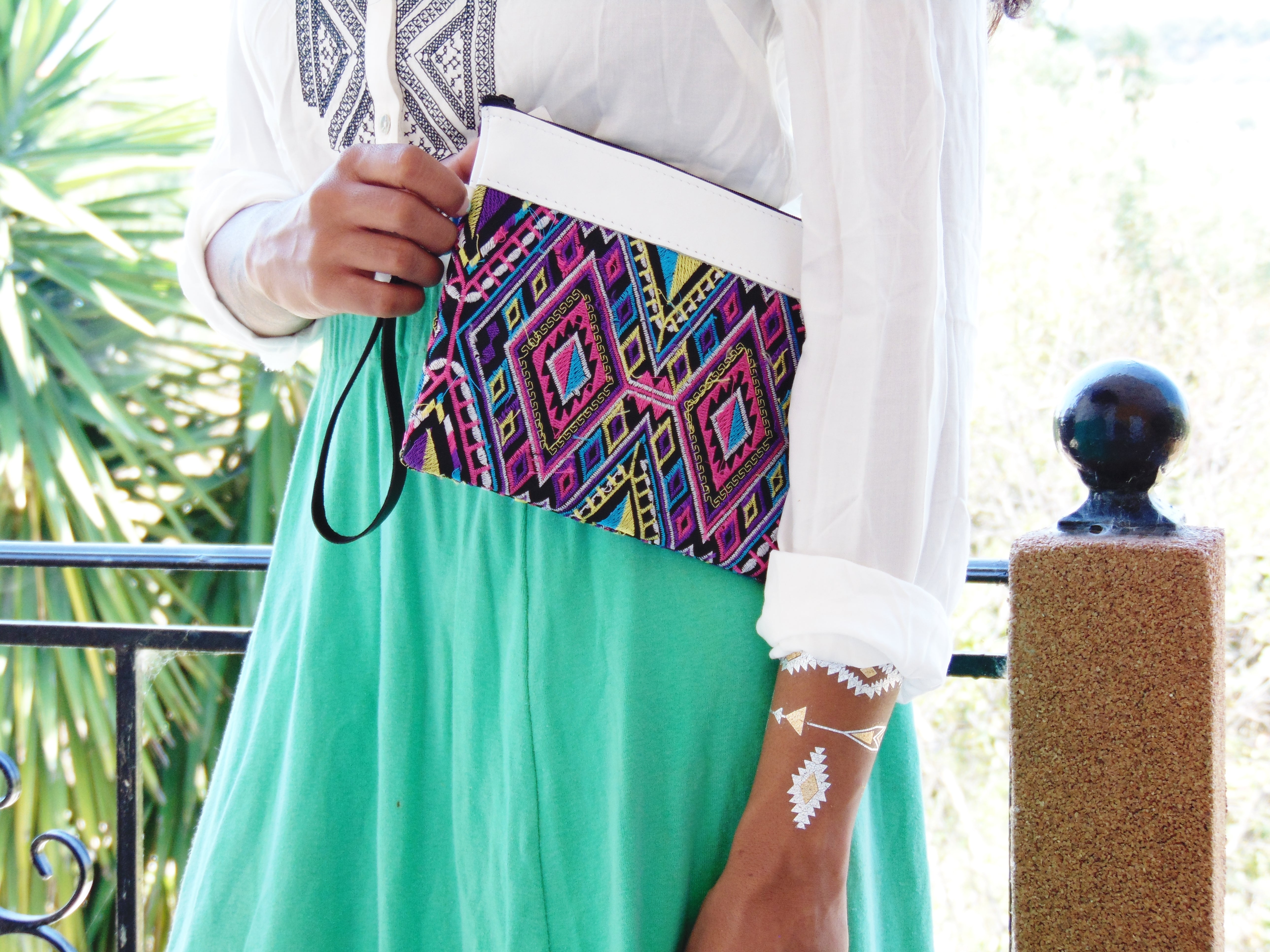
Our Hmong textile collection is made from real vintage upcycled paj ntaub. Not a print. Not a reproduction. The actual fabric — sometimes decades old — given a new life as something you carry every day.
Which means the spiral on your bag was placed stitch by stitch by a woman's hands. The elephant foot was chosen with intention. The colors were selected to say something. You're not carrying a pattern.
You're carrying someone's story..


- Every piece is one of a kind. The vintage fabric is never the same twice — which means no two Lumily Hmong pieces are ever identical. When it's gone, it's gone.
One-of-a-kind. Real vintage paj ntaub. Real story.
Shop the collection — bags, clutches, wallets, and more.
Why This Tradition Almost Disappeared

Here's the part that stays with us.
Younger generations of Hmong women have less and less time to learn paj ntaub. The elders who hold the deepest knowledge — who know not just the stitches but the meanings. Are aging. The practice of sitting across a loom from your grandmother and learning symbol by symbol is becoming rare.
With diaspora communities spread across the world, oral transmission is becoming harder to maintain. It once kept this tradition alive for centuries.
"Embroidery was resistance. It was memory. It was grocery money."
This is why we work with artisans like Pranee, who treat these textiles with the reverence they deserve. Why we choose vintage and upcycled? because honoring the original makers means treating their work as the irreplaceable thing it is.
Questions We Hear All the Time
Q: What does paj ntaub mean? Paj ntaub (pronounced pa ndau) means "flower cloth" in. It's the name for the traditional hand embroidery that women have practiced for generations. The designs are intricate and geometric, packed with cultural meaning. The name comes from how the patterns radiate from a center point. They spread outward like petals from a flower.
Q: What do the spiral patterns in the textiles mean?
The spiral — or snail motif (qab qwj) — represents family across generations. The center coil is the ancestor, each outer ring is a new generation. A double spiral means two families joined through marriage. It's a family tree, stitched in thread
Q: Is it respectful to wear Hmong textiles if you're not Hmong?
Such a thoughtful question. Most artisans and cultural advocates welcome genuine appreciation. They especially welcome it when pieces are purchased from original makers or ethical brands that support the community. Learn what the symbols mean and know where your piece came from. Then wear it with the respect it deserves. That's not appropriation. That's honoring the craft.
Q: How long does it take to make a piece of embroidery?
Traditional paj ntaub is extraordinarily labor-intensive. A single skirt border can take weeks or months. A complex story cloth can take up to a year. Each piece represents a massive investment of skill, time, and intention. This is why authentic textiles carry real, lasting value.
Q: What is the difference between traditional paj ntaub and a story cloth?
Traditional paj ntaub uses abstract geometric symbols — spirals, crosses, triangles — that carry coded cultural meaning. Story cloths emerged in Thai refugee camps in the late 1970s. They are figurative and depict scenes from Hmong history and life. Both are paj ntaub. Story cloths were born from a specific, heartbreaking historical moment.
Q: Where can I buy authentic upcycled Hmong textile bags?
Look for brands that source directly from artisans working with real vintage paj ntaub fabric — not printed reproductions. Lumily's Hmong textile collection is made from authentic vintage fabric by artisan partner Pranee in Northern Thailand. Shop: Lumily
A Language That Refused to Die

The oppressors saw pretty stitching.
These women knew they were writing.
That's the thing about craft that carries meaning — it can outlast anything. Borders. Bans. Wars.
Camps. Generations of loss. The thread keeps going.
We're honored to carry a small part of that thread at Lumily. And we're grateful that every time you choose one of these pieces, you're helping carry it too
- Want to go deeper? Read our guide to Hmong textile symbols and meanings, or meet all of our artisan partners.
Every Lumily piece supports real women. Real craft. Real communities.
When you buy from Lumily, you're part of keeping this alive.


Leave a comment